Wednesday, 12 June 2019

The Australian Designer Who Invented a New Vehicle Category by Rain Noe

"Form follows function" is what they taught us in design school. But when I look at modern products--furniture, cars, bottles, consumer electronics--it seems many designers aim to make something look "different," just for the sake of being different. Zig zags, arbitrary curves and surfaces with no relation to each other seem to have been added purely because the designer's CAD package made such forms possible.

In contrast, I find it both fun and educational to look back at a time when industrial design was in its infancy, and the established form factors of today had yet to be worked out. Everything from the individual taste of the designer, to global economic conditions, to local idiosyncrasies, to sheer manufacturability could influence what lines made it onto the page and subsequently into factory production.

For today's example we go back to a dusty farm in Australia weathering the Great Depression. The combination of the farmer's wife being literate, and Australia having an established postal system, were unwittingly about to spark the creation of an entirely new form factor that persists to this day.

__________________

In the 1920s cars in Australia, as elsewhere, were an expensive luxury, but local banks made them affordable by offering credit. That is, until the Great Depression of the 1930s hit. At that point, the banks yanked credit programs for cars, though left them intact for working vehicles for farmers. That's tractors, riding machinery, and this new thing called a "pickup truck," which was a Ford Model T (later A) modified to carry a cargo box on the back.

An early Ford pickup truck.

Pickup trucks back then weren't like the pickup trucks of today. Rough-riding, utilitarian and largely open-air, these were used for actual work, not the double-duty family outings they're used for today. And this arrangement dissatisfied at least one farm-based married couple in Gippsland, Victoria in 1933. The wife of the couple broke out some stationary and wrote a letter to Hubert French, the managing director of the Ford Motor Company of Australia:

"My husband and I can't afford a car and a truck," her letter read, "but we need a car to go to church on Sunday and a truck to take the pigs to market on Monday. Can you help?"

French could've crumpled the letter up and thrown it in the garbage, but instead he passed it on to his sales manager, Scott Inglis. Inglis then forwarded it to Slim Westman, the plant superintendent. Westman brought the letter to a 22-year-old kid named Lewis Bandt, who was Ford Australia's sole designer. They apparently deemed the farmer's wife's needs relevant, and started a discussion: Could they design and produce something that would fulfill this requirement? Was it possible for a car to do truck duty? How heavy is a pig?

"Westman quite rightly reckoned that if we cut down a car and put a tray on the back, the whole thing would tear in half once there was weight in the back," Bandt later said. "I told him I would design it with a frame that came from the very back pillar, through to the central pillars, near the doors. I would arrange for another pillar to further strengthen that weak point where the cabin and tray joined. I said to Westman `Boss, them pigs are going to have a luxury ride around the city of Geelong!'"


Bandt began working his ideas out in 1:1 scale, drawing orthographic views on a massive 30-foot-long blackboard. He showed the completed design to Westman, who then authorized the production of two prototypes.

Bandt (standing) in 1933. Behind him you can see the blackboard on which the full-sized drawing was done.

The prototypes were shown to Inglis, who green-lit £10,000 for tooling and a limited production run of 500 units.

In January of 1934 the new Ford Coupe Utility, based on the Model 40 coupe, started rolling off of the assembly line.

It had the face of a car--respectable, church-parking-lot friendly--yet could indeed haul pigs (or any weight up to 1,200 pounds) in the rear, strengthened by Bandt's monocoque design and powered by Ford's V8 engine. Business in the front, party in the back, this was an early automotive version of a mullet.

To our 21st-Century eyes, it may be tough to recognize this vehicle's design victory. To understand what Bandt had achieved from a design perspective, look at this 1931 Ford Model A pickup truck:

A 1931 Ford Model A pickup truck.

You can see how the passenger cabin and the truck's bed have little to do with each other. In contrast, look at how Bandt connected the cabin and the bed's sidewalls into a continuous form, not just for looks, but for strength:

Bandt's 1934 Coupe Utility.

The one in the photo above is admittedly in pretty rough shape. To get an idea of what Bandt's design looked like new, check out this restored version:

Bandt had essentially created a new automotive form, and one that became particularly popular in Australia and New Zealand. "Utes," as they were called, gained a firm footing throughout the 1930s and '40s.

A ute on an Australian farm, circa 1939.

You'll notice that the restored yellow car in a photo above has a door handle in the modern position. However, the car was originally designed with "suicide" doors, as was common at the time. Here's a photo of Bandt, decades after designing the original ute, alongside a restored one:

Bandt's story ends tragically. He put in a full career as a designer for Ford, retiring in 1975. Some eleven years into his retirement, he managed to find an original 1934 Coupe Utility and restored it. In 1987 he was driving it home from the Australian Broadasting Corporation's television studios--where he was being featured in a documentary about utes--and got into a head-on collision with a sand truck. Ironically, Bandt died inside of one of his most influential designs.

Up next, we'll look at the incredible profusion of vehicle designs that Bandt's creation unwittingly kicked off.


from Core77 http://bit.ly/2WD3ZJb
via IFTTT

Fusion 360 — Model Circular Tool Holder — Ask LarsLive by Lars Christensen

Fusion 360 — Model Circular Tool Holder — Ask LarsLive
Model Circular Tool Holder is a snippet of Sunday's Ask LarsLive. You Can watch the full episode here: https://youtu.be/TnJrfqBzpww (The advice in my videos are my own and are not intended to represent the views of my wife, children or employer) My email: lars.christensen@autodesk.com Want to learn more about Fusion 360? Check out this link: http://autode.sk/2rXApL2 Free CNC Handbook: http://bit.ly/2c2ivku LET'S CONNECT: https://twitter.com/Lars_cadcam http://bit.ly/2J3nP9k http://bit.ly/2jSQ3I3 MY BLOG, cadcamstuff.com: http://cadcamstuff.com/


View on YouTube

Tuesday, 11 June 2019

Frameworks for Utopia Reflected on the Past to Envision Possibilities for the Future by Molly Millette

In their latest exhibition, Furnishing Utopia 4.0: Drawing Upon Frameworks, Furnishing Utopia collaborated with Herman Miller to continue exploring connections between design values across history.

Photo: Katrin Greiling

Linking the Shakers' design goals of creating Heaven on Earth to the Modernists' ambitions of designing new ways of living, the collective asked that designers reflect on the past to envision possibilities for the future.

Photo: Katrin Greiling

A workshop, American Modernism, a Midwest Tour, led to participants discovering physical and conceptual framework designs for life, work, and methodologies—all of which shared the goal of improving people's ways of life.

Responding to discoveries made in the workshops, the designers' efforts came together as a show during NYCxDesign, Drawing Upon Frameworks. Composed of drawings and other two-dimensional work—that's right, no three-dimensional prototypes or objects in this industrial design exhibit—the compilation showcases each designer's playful interpretations of the literal and conceptual ideas and forms that surround each of us in daily life.

So, why drawings? Seeking to capture the first moment that an abstract thought appears as a form, the designers embraced the challenge of ideating, exploring, and creating, without the use of CAD and other digital imagery tools that dominate industrial design today.

Photo: Katrin Greiling

Beginning with familiar ideas and interpreting them in an unfamiliar, though engaging, way allowed each designer to make new discoveries.

Photo: Shigeki Fujishiro

While the show is sadly no longer on view, you can check out Furnishing Utopia for more information.


from Core77 http://bit.ly/2wKviSf
via IFTTT

Fusion 360 — Manipulate Origin for Mesh File — Ask LarsLive by Lars Christensen

Fusion 360 — Manipulate Origin for Mesh File — Ask LarsLive
Manipulate Origin for Mesh File is a snippet of Sunday's Ask LarsLive. You Can watch the full episode here: https://youtu.be/TnJrfqBzpww (The advice in my videos are my own and are not intended to represent the views of my wife, children or employer) My email: lars.christensen@autodesk.com Want to learn more about Fusion 360? Check out this link: http://autode.sk/2rXApL2 Free CNC Handbook: http://bit.ly/2c2ivku LET'S CONNECT: https://twitter.com/Lars_cadcam http://bit.ly/2J3nP9k http://bit.ly/2jSQ3I3 MY BLOG, cadcamstuff.com: http://cadcamstuff.com/


View on YouTube

Running on Sunshine, Grouphug's Window Charger Rebrands Environmentalism by Kickstarter Design & Tech

"I hate camping," says Krystal Persaud, "like, a lot."

When she shares prototypes of her solar-powered phone charger for feedback, she often gets suggestions—often from men—to make it portable enough to throw in a backpack for camping. The former senior director of the product design team at littleBits isn't interested in that advice. "You might go camping once a year; you live in your apartment every day. And I don't want to hang some Velcro camouflage solar panel in my window," she says.

Soon, she won't have to. Today she's launching a Kickstarter campaign to manufacture the Grouphug Window Solar Charger. Instead of creating a solar-powered phone charger for rugged outdoorsmen, she's designed one for stylish apartment dwellers. She hopes it can be a "Trojan horse" to help normalize environmentally friendly choices for consumers who might not have thought of themselves as eco-conscious before—and that the daily recharge will inspire her backers to take bigger steps toward environmentalism.

The Grouphug Window Solar Charger aims to add some environmentalism to daily routines.

From littleBits intern to employee three to design director

After graduating from Georgia Tech's industrial design program, Persaud had trouble finding a job. "I had this intense philosophy about designing sustainable products that should be educational. I couldn't imagine working anywhere where I would have to change my philosophy." Eventually, she connected with Ayah Bdeir, the CEO of littleBits, who was just starting to build out a team for her open-source electronic toy company.

Persaud joined on a six-month design internship. She ended up staying for more than six years, rising through the ranks as a product manager and product designer before becoming the senior director of product design and strategy, running weekly user testing workshops and launching big products with Disney and Lucasfilm and Marvel.

Persaud gained a huge appreciation for user testing at littleBits. "As the director, it was hard for me to answer a lot of questions about what a child would want—I'm not an eight-year-old, so what I like doesn't matter." Her team brought in representative groups of kids to test out the toys and gain insights directly from them. Their responses—good and bad—helped shape the products. "Kids would cry," she says. "Imagine if we didn't do that, and we shipped hundreds of thousands of those [test sets] out."

Try this at home

Persaud knew she wanted to start her own company one day, but it was hard to leave littleBits. And she knew she wanted to create an environmentally friendly product, but she wasn't sure what. She quit her job and started spending a lot of time tinkering with green tech, applying the same human-first approach that she'd honed at littleBits.

"I asked people about sustainable habits, and what they would be interested in doing. Composting and gardening came up a lot, but solar did too, often as a question, like, 'I know that I should go solar, but I don't own a house. How would I possibly do that?' I thought that was interesting. You only don't know how to do it because there's not a solution for you, but there easily could be."

Or, at least, she thought it would be easy. She soon came up against the complexities of solar energy. "The first five panels I made shattered—if you drop the thin silicon wafers like an inch, they break. And I started off with a six-watt panel, which is not enough for phones. My battery was wrong; it was taking too long to charge, and it couldn't fully charge my phone.

"I also started talking to people who work at solar panel companies, asking them really basic questions like, 'Why are solar panels rectangles? Why are they blue? Why are they always big? Can solar panels be in fun shapes?' And they were like, 'They can, but why would you do that?' I learned it was just about manufacturing efficiency and costs. When the engineer said that you could have a solar panel in any shape and no one was doing that, it felt huge."

She learned that she could make shapes that are more whimsical—and created a custom cat-shaped solar panel for an exhibition at the New York Hall of Science. She learned that monocrystalline cells from a company called SunPower are more durable, energy-efficient, and long-lasting than the cheaper polycrystalline cells she had been shattering before. "They developed a patented system that layers in a copper netting that goes on the back so that they literally can't break," she says. "They would bend a little, but would still work."

Her final product uses those panels—rated to last 25 years and with best-in-market efficiency of 22 percent—and takes 10 hours of direct sunlight to gather enough energy to charge a phone. Because the panels are so long-lasting, Persaud worked on a modular design that could be repaired every few years when the battery needs a refresh.

Rethinking green branding

"I think if you saw me on the street, you wouldn't assume that I was an 'eco person,'" Persaud says. "I am, but I also value convenience and fashion and home decor. I'm not willing to compromise on those things to be sustainable, as awful as that sounds. And I think a lot of people are like that."

As she's prepared for the release of her solar chargers, she's been thinking about challenging the aesthetics typically tied to environmentalism as a way of reaching a wider audience.

"Historically, designers have thought that consumers need to see, like, a leaf in your logo, the product needs to be green, the whole thing needs to look recycled," she says. "I think it really limits the adoption rate and popularity of products, because it's this clunky aesthetic that not everyone is interested in. It's not a good way to break out of the niche."

She identifies more with brands like Everlane and Allbirds, "which are doing sustainable things that look like mainstream, beautiful designer goods. I want to basically do a Trojan horse eco-product that you want no matter what, and it just happens to be good for the environment.

"I'm tired of the SkyMall look," she adds. "A lot of the reason why I think that this has been such an untapped area is because a similar demographic of people—guys—have been designing solar panels, and these companies are obviously not talking to people."

Her approach is more playful. She developed a "suncatcher" model with plastic prisms that spray rainbows into a room, thinking it would be Instagram-friendly, but found the effect was too inconsistent from window to window. She tested out a variety of styles and landed on a bamboo frame that testers liked because it fit in best with many styles of home decor; she started selling prototypes last holiday season to validate the market for it.

"You don't have to overturn capitalism to be sustainable," she says. "Just fuel it with environmental stuff that people want."

The Grouphug Window Solar Charger is live on Kickstarter through July 10, 2019.


from Core77 http://bit.ly/2R55qKf
via IFTTT

Monday, 10 June 2019

Ask LarsLive Fusion 360 — Sunday Edition — Episode 6 by Lars Christensen

Ask LarsLive Fusion 360 — Sunday Edition — Episode 6
The Ask LarsLive is my way of trying to providing as much value as possible. I take the questions from my email inbox and trying to answer them the best I can. (The advice in my videos are my own and are not intended to represent the views of my wife, children or employer) My email: lars.christensen@autodesk.com Want to learn more about Fusion 360? Check out this link: http://autode.sk/2rXApL2 Free CNC Handbook: http://bit.ly/2c2ivku LET'S CONNECT: https://twitter.com/Lars_cadcam http://bit.ly/2J3nP9k http://bit.ly/2jSQ3I3 MY BLOG, cadcamstuff.com: http://cadcamstuff.com/


View on YouTube

Sunday, 9 June 2019

Fusion 360 — Extrude on a CURVE Look Up for LOFT — Ask LarsLive by Lars Christensen

Fusion 360 — Extrude on a CURVE Look Up for LOFT — Ask LarsLive
Extrude on a CURVE Look Up for LOFT is a snippet of Sunday's Ask LarsLive. You Can watch the full episode here: https://youtu.be/LZcI3Po_1X8 (The advice in my videos are my own and are not intended to represent the views of my wife, children or employer) My email: lars.christensen@autodesk.com Want to learn more about Fusion 360? Check out this link: http://autode.sk/2rXApL2 Free CNC Handbook: http://bit.ly/2c2ivku LET'S CONNECT: https://twitter.com/Lars_cadcam http://bit.ly/2J3nP9k http://bit.ly/2jSQ3I3 MY BLOG, cadcamstuff.com: http://cadcamstuff.com/


View on YouTube

Saturday, 8 June 2019

Third Year Industrial Design Skills that you SHOULD KNOW! by Jimmy Huynh

Third Year Industrial Design Skills that you SHOULD KNOW!
3rd Year Industrial Design projects sketching and skills! Check out Year 1 and 2 Skills! https://www.youtube.com/watch?v=_LSw68SSBeY https://www.youtube.com/watch?v=Pd6WZ_RQ-oU https://www.youtube.com/watch?v=ZjoLpNqf9So https://www.youtube.com/watch?v=orv6ksx8aGc My Portfolio http://bit.ly/2K4wGb6 My Instagram http://bit.ly/2MBlBjT Get The Pens Here: https://amzn.to/2GAA8sv https://amzn.to/2EgUg0c Metal Peg Board: https://amzn.to/2VyBBUj Peg Board Hooks: https://amzn.to/2SH85cY My Main Camera https://amzn.to/2GPaMrC My Microphones https://amzn.to/2Sqbcpv https://amzn.to/2CHqOjl https://amzn.to/2BQQXdM Microphone Setup Parts https://amzn.to/2ViLBAS https://amzn.to/2BQRix4 https://amzn.to/2VjFZq0 My Lights https://amzn.to/2Aq1DjE


View on YouTube

Building design sketches by product designer maker


New video by product designer maker: Building design sketches https://youtu.be/CpFDnO8HUnk

Fusion 360 — How to FIX a BROKEN Extrude Pattern — Ask LarsLive by Lars Christensen

Fusion 360 — How to FIX a BROKEN Extrude Pattern — Ask LarsLive
How to FIX a broken extrude Pattern is a snippet of Sunday's Ask LarsLive. You Can watch the full episode here: https://youtu.be/LZcI3Po_1X8 (The advice in my videos are my own and are not intended to represent the views of my wife, children or employer) My email: lars.christensen@autodesk.com Want to learn more about Fusion 360? Check out this link: http://autode.sk/2rXApL2 Free CNC Handbook: http://bit.ly/2c2ivku LET'S CONNECT: https://twitter.com/Lars_cadcam http://bit.ly/2J3nP9k http://bit.ly/2jSQ3I3 MY BLOG, cadcamstuff.com: http://cadcamstuff.com/


View on YouTube

Friday, 7 June 2019

Why You Shouldn't Be Surprised by Apple's $1,000 Monitor Stand by Rain Noe

At this week's Worldwide Developer Conference, Apple announced their new Mac Pro desktop, Pro Display XDR monitor and Pro Stand. The latter is a rather sophisticated piece of design and engineering:

"The Pro Stand makes every adjustment of your display feel seamless. Precision tilting and 120 mm of height adjustment help Pro Display XDR adapt to any viewing condition. The angle of the display stays true even as you adjust the height. With the Pro Stand, you get a display that feels weightless, moves effortlessly where you want it, and stays exactly where you leave it."

In the latest "let's make a big deal about something" outrage-fest that our society is now addicted to, the Pro Stand has supposedly drawn a backlash for its $999 price. CNN breathlessly reports "Apple monitor stand that costs more than an iPhone sparks online uproar." Engadget writes "A $999 monitor stand is everything wrong with Apple today." Gizmodo says "$1,000 feels like a lot of money for a monitor stand."

That's because it is a lot of money for a monitor stand.

So let me pick this "backlash" nonsense apart, and let's look at this thing from an industrial design and company ethos point of view.

First off, the Pro Stand is not designed for the average consumer. It damn sure isn't designed for me. The Pro line of objects is designed for hardcore professionals, for deep-pocketed people and companies who can drop five figures on a workstation no sweat. It's for people who actually need the 28 freaking cores that the Mac Pro can handle. They'll drop the money because they'll make it back, or because they're in situations where money is no object.

Jonathan Ive may be one of the most powerful designers on the planet, in terms of being able to call shots. It's well-known that Steve Jobs stipulated, prior to his demise, that within Apple's structure Ive was not to be interfered with. There is no accountant above Ive going "No, I don't think so."

So what do you think Ive's brief was when designing the monitor stand? "Come up with something low-cost that we can sell at Wal-Mart?" No. More than likely, the assignment was to design the finest monitor stand money can buy. More than likely, he set out to design his version of the ultimate monitor stand, one with a fine-tuned, hinged connection point that is probably exponentially more precise than what everyone else is making. Something that a team of engineers had to burn a lot of midnight oil to realize. Jonathan Ive has that kind of juice. Most designers don't.

That's why I feel any other industrial designer can't begrudge Ive. We can be jealous of him, but we can't begrudge him. What would you do in his shoes, with those kinds of resources and that kind of clout?

Look at the grill on the Mac Pro and the monitor. In the promo video, he mentions the grill portion of the housing is CNC-machined on both sides. Could he have figured out a cheaper way to do it? Probably. But the point is, he no longer has to. He works for Apple, where his track record has earned him the right to do things the way he wants to do them. Whether or not you like his aesthetic choices or his chosen manufacturing techniques, that ability to call shots is every designer's dream.

So why the "backlash?"

I see what's happening with Apple as the same as what's happening with our society. The rich and the poor are getting further and further apart. Apple doesn't design for poor people. It could even be argued they don't design for middle-class people. They design for people who can afford $1,000 phones, which leaves me, a middle-class former Apple loyalist, behind.

I think people are angry because they are getting left behind by a brand they once loved. I myself didn't realize overnight that Apple had moved past me; it sank in gradually.

Apple's stuff has always been more expensive than their competitors', but from the moment I had enough money to buy my own computers and objects, I saved up for them, and wouldn't consider using anything else. Because all of their stuff worked for me exactly they way I wanted them to work. Steve Jobs didn't sound like a fun guy to have a beer with, but the man damn sure knew his UX. After years of lugging around a case of cassettes, CDs and later MiniDiscs, iTunes and the iPod was precisely what I dreamed of. The iPhone, the iPad, my MacBooks, they all did exactly what I needed them to, without me needing to get under the hood.

Gradually it began to change. The OS's became bloated. iTunes became more and more confusing, changing the UI that I'd memorized over and over again. I now need to Google how to do even basic things* with my phone or fix something on my computer. Apple's original "you don't even need an instruction manual" ethos seemed to disappear. I figured it was my age; I now pride myself on how little I touch my phone throughout the day, whereas the generation before me can't seem to get their faces out of them. I assume those younger folks, who are tech-savvier than I, have no problem operating their devices. They grew up with them and understand how to get them to do what they want.

______________________________________

*[One example: My low-tech wife still listens exclusively to CDs. For her last birthday I bought her an iPod. I loaded all of her music onto it, excited at how much easier this would make her life. Once the iPod was loaded, she tried using it, and asked me a simple question: "How can I see every Prince song I own, as a list?"

"Easy," I said, "just do this--" I then futzed with the iPod, and couldn't figure out how to do it. I Googled it. Still couldn't figure it out.

What my wife wants is to be able to see a list of every Prince song she owns, then select the one she wants to hear. To me that is completely logical and rational. But when you select Prince, it shows you a bunch of little squares depicting his albums. If you remember which album every Prince song belongs to, no problem. But if you're like us and don't remember, you have to click on each album in turn to scroll through the list to find the song you'd like to hear. This doesn't make any sense to us, but presumably makes sense to Apple. We are not their target market.]

______________________________________


Apple has evolved, and I have not been able to evolve along with them, nor increase my earning power to keep up. They have never branded themselves a product company for the masses. When he was still alive, Steve Jobs pointed out that Mercedes-Benz charged a lot more for a car. With their $1,000 phones and now monitor stands, Apple is steadily moving upmarket to provide high-quality goods to the rich. It's actually a great business model, and one with a ready market; Investopedia, after crunching Boston Consulting Group's data, concluded that 1,700 millionaires are made each day.

As a design blogger, I'll never be one of them. Does that make me sad? Yeah. Angry? No. I was trained as an industrial designer, and I live in a time where I get to witness a talented industrial designer with massive resources at his disposal execute his visions absent interference from bean counters. I find that fun to see; a subset of Apple's products and pricepoints are what design unfettered by economic constraints looks like.

My own monitor stand is made from dovetailed pieces of scrap wood. I learned how to cut the dovetails myself by taking a class. My stand doesn't have a swivel nor magnets because I don't need to rotate my monitor nor disconnect it. It doesn't adjust in height because I measured the exact height I needed and built to that. Like Jonathan Ive, I used the resources available to me to create what I wanted, and it is perfect for me.

I think the "backlash" against the Pro Stand is comprised of a bunch of self-entitled whiners who want the design and engineering contained within it, but can't afford it. That's a bad road to go down; it never ends, and every single object you own likely has a better version of it for sale. Take my advice and stop coveting. If your phone lets you down, find ways to use it less. If you want something you can't afford, design and build your own, to suit your own needs. It may not look as cool, but you will find it strangely satisfying.


from Core77 http://bit.ly/2EW5wPk
via IFTTT

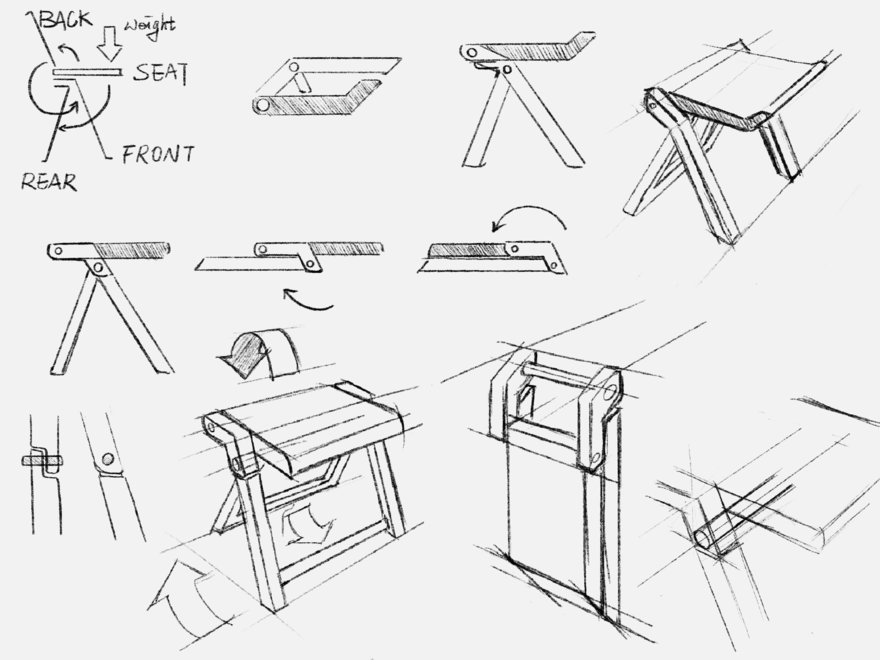
Great Industrial Design Student Work: The Attaché Folding Stool by Rain Noe

"There are some problems with folding furniture," observed mechanical engineer Chi-Hao Chiang, who left his native Taiwan to pursu...